How topical humour became Amul's strongest brand asset
Guest Column: Ganapathy Viswanathan, Independent Communication Consultant & Author, writes on how Amul’s iconic ads became a cultural archive of India’s changing times through wit and consistency
 by
by
Published: Jun 13, 2026 9:12 AM | 6 min read
 Follow Us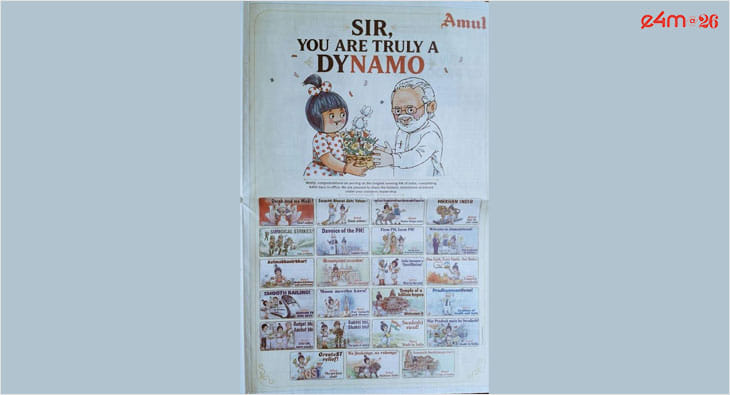

- Amul has established itself as a trusted household brand in India, built on decades of product quality and word-of-mouth recommendations, transcending typical marketing strategies to become a part of everyday culture.
- The brand's advertising, particularly its topical campaigns, has effectively captured and commented on major events, showcasing a unique ability to engage with current affairs while maintaining a consistent and recognizable brand identity.
- Amul's advertisements utilize gentle humor and clever wordplay, often in Hinglish, allowing them to resonate with a broad audience without being offensive, thus avoiding backlash that many brands face in sensitive contexts.
- Over the years, Amul's campaigns have evolved from traditional hoardings to social media, yet the core idea of joining the conversation around cultural moments has remained unchanged, creating an unofficial timeline of modern India through its advertisements.
For many Indians, Amul was never a brand they discovered. It was simply there. On the breakfast table, in the refrigerator, in school lunch boxes and family kitchens. Long before marketers began talking about customer loyalty and brand love, Amul had already secured something far more valuable—trust.
That trust was built over decades through product quality and word of mouth. Families recommended Amul to families. One generation passed it on to the next. But while the products built the business, it was the advertising that gave the brand a personality.
And what a personality it turned out to be.
More Than a Dairy Brand
There are successful brands, and then there are brands that become part of everyday culture. Amul belongs to the second category.
For decades, it has done something most brands struggle to achieve. It has remained relevant without constantly reinventing itself. In an age where brands rush to jump on every trend, Amul has managed to stay current while remaining unmistakably Amul.
A large part of that comes from its famous topical advertisements. Somewhere along the way, the brand stopped being just a dairy company and became a chronicler of the times.
Turning Headlines into Punchlines
Think about any major event in recent memory—a World Cup victory, a blockbuster film, a political development, a business milestone or even an international story making global headlines. Chances are, Amul had something to say about it.
The remarkable part is not that the brand commented on these events. It is how quickly it did so.
Before social media made real-time marketing fashionable, Amul had already mastered it. A major story would break and, almost before the public discussion had settled, an Amul creative would appear with a clever twist on the headline.
The format rarely changed. A caricature, a witty line, a visual pun and the familiar Amul girl. Simple ingredients, yet incredibly effective.
The best communication often looks effortless. But anyone who has worked in advertising knows there is nothing easy about consistently finding the right idea at the right time.
A Fine Line Few Brands Can Walk
One thing that has always fascinated me is the range of people who have appeared in Amul's advertisements over the years.
Prime Ministers, politicians, film stars, cricket legends, industrialists and international celebrities have all found a place in the Amul universe. Yet unlike many brands that enter sensitive territory and find themselves in trouble, Amul has largely managed to stay on the right side of public opinion.
Why?
Perhaps because the brand understands the difference between commenting on an event and taking ownership of it.
The personalities are usually part of the story, not the story itself. The advertisements are built around the moment rather than around an endorsement. More importantly, the humour is rarely cruel. It pokes fun without being offensive and observes without sounding judgmental.
That's a difficult balance to maintain, especially in today's environment where even a well-intentioned campaign can trigger backlash.
Humour Is the Real Hero
If there is one reason these advertisements have survived for so long, it is humour.
Not the loud, attention-seeking kind. The gentle kind that makes you smile and move on with your day.
The audience already knows the news. Amul simply adds a fresh perspective. Sometimes it is clever. Sometimes it is cheeky. Occasionally it makes you groan at the pun. But it almost always leaves an impression.
And perhaps that is why people remember the ads. They never feel like hard-selling. The product sits quietly in the background while the idea takes centre stage.
Many brands talk to consumers. Amul joins the conversation.
Different Headlines, Same Brand Soul
The world has changed dramatically since the first Amul topical appeared. Governments have changed. Film stars have come and gone. Media habits have been transformed.
Yet the campaign still feels familiar.
The Amul girl remains. The wordplay remains. The light-hearted tone remains.
That consistency is easy to overlook, but it may be one of the campaign's greatest strengths. While countless brands have changed logos, slogans, identities and personalities, Amul has stayed remarkably true to itself.
The topics change every week. The brand character doesn't.
From Hoardings to Hashtags
For many years, the campaign lived on hoardings.
In cities like Mumbai, spotting the latest Amul billboard became part of the urban experience. People would slow down at traffic signals and look up to see what the brand had made of the latest headline.
Looking back, those hoardings were doing what social media does today. They reacted quickly, sparked conversations and gave people something to share.
When platforms like Facebook, Instagram and X arrived, Amul didn't have to learn a new trick. The brand had been creating shareable content long before anyone used that phrase.
The medium changed. The idea didn't.
Speaking in Hinglish
Another interesting aspect of the campaign is its language.
Most Amul advertisements speak in Hinglish—a mix of Hindi and English that feels natural to urban India. The wordplay often depends on this blend, which is why the headlines have a flavour all their own.
I've often wondered how some of these pun’s land in markets where Hindi isn't widely spoken. Then again, perhaps the words are only part of the story. The visual, the context and the shared cultural moment usually do much of the heavy lifting.
The campaign may be written in Hinglish, but its appeal travels well beyond language.
An Archive of Modern India
Spend a few hours looking through old Amul advertisements and something interesting happens. You stop looking at them as advertisements.
Instead, they start to feel like snapshots of India's journey.
Cricket victories, election results, blockbuster films, economic milestones, global events and cultural moments all find a place in the collection. Together, they form an unofficial timeline of modern India.
That may be Amul's greatest achievement.
The brand didn't become iconic because it chased attention. It became iconic because it stayed connected to what people were talking about, year after year, decade after decade.
Great brands sell products. The rare ones become part of a nation's memory.
Amul has managed to do both.
Disclaimer: The views expressed here are solely those of the author and do not in any way represent the views of exchange4media.com.
Read more news about Marketing News, Advertising News, PR and Corporate Communication News, Digital News, People Movement News
For more updates, be socially connected with us onInstagram, LinkedIn, Twitter, Facebook, YouTube & Google News